Showing posts with label grade inflation. Show all posts

Wednesday, September 27, 2006

The Graham Spanier Award for Most Outrageous Spin Goes to...

The Collegian today has a truly stupid editorial in which they try their hand at turd polishing. Mount Nittany Medical Centre received 353 blood-alcohol emergency room visits during the 2005-2006 school year. How do you put a positive spin on this?
In a twisted sort of way, the numbers at Mount Nittany Medical Center probably represent a good thing. It just might mean that students are learning to err on the side of caution when it comes to possible alcohol poisoning.
The appallingly high number of students treated for alcohol related problems is an indication of more responsible behavior on the part of the students. That is bullshit worthy of Spanier. See what happens Graham when you set a bad example. The Collegian also breaks out this old saw to defend the party hearty crowd.
It is part of our culture. Penn State students study hard during the week and party hard during the weekend. We maintain a balance of work and fun that, overall, contributes to our lives.
Of course, here in Happy Valley the weekend starts on Thursday.

The truth is that most Penn State students are not challenged academically. Remember that in 2002 nearly 40% of all grades awarded at Penn State were A's and the University is ninth this year on the Princeton Review list of schools where you don't have to study. I think Penn State student Joel Gilchrest said it better in the Pittsburgh Post-Gazette,"We have a motto here: Party hard, drink hard ... I mean, party hard, study hard. "

Tuesday, September 19, 2006

Spanier Speaks: He Doesn't Like Princeton Review.

Adam Smeltz at CentreSquawker noted on Monday that at last week’s Trustees meeting, Spanier addressed the Princeton Review ranking of Penn State as the number two party school in the nation. I think Adam was too generous to Spanier on his blog. Here is what Spanier said and my analysis of it.

The fall is also a time when college rankings come out. Some of them use meaningful measures to gauge a university's progress and some of them are, frankly, pretty silly.

On the silly side is the Princeton Review party school ranking, in which Penn State placed second.

I mention this only because of all the media attention it got. This particular "review" is little more than a publicity stunt to help them sell their guide, and involves people going to a Web site and voting for the school they want to name the winner. It could actually be more reflective of a school's overall popularity, but it has no legitimate basis for its conclusion.

As I have said to many people, we want students who come to Penn State to enjoy their college experience, and we think this is a fun and engaging environment, with lots for students to do. But the ranking is nothing more than a clever marketing trick to get attention to their guide, and the media naively buy into it every year.


There is just so much crap here it is hard to know where to begin in pulling it apart.

I guess the best place is with the sentence I’ve emphasized. This is a rather weak attempt put a positive spin on a ranking that places Penn State in a light which Spanier clearly thinks is negative. His denial that “it has [..] a legitimate basis for its conclusion,” is at best disingenuous. As I have noted elsewhere, Penn State flack Bill Mahon acknowledged the obvious to the CDT the day after the rankings were released: Penn State has an alcohol problem.
...[W]ith the amount of marketing of alcohol, he [Bill Mahon] is surprised the university isn't number one. He said 353 Penn State students were taken to the emergency room for alcohol overdoses last year.

Mahon follows Spanier’s public relations strategy for dealing with this problem by placing the blame for this problem outside the University. The fact that the ranking focuses the light back on Penn State is what has Spanier upset.

Let’s take the magnifying glass to a bit more of Spanier’s prepared remark.
As I have said to many people, we want students who come to Penn State to enjoy their college experience, and we think this is a fun and engaging environment, with lots for students to do. But the ranking is nothing more than a clever marketing trick to get attention to their guide, and the media naively buy into it every year


The fact is that Spanier’s response to the ranking, the banning of alcohol at tailgates while games are in progress, is nothing more than a clever marketing trick to shift attention away from the ranking and the media has naively bought into it. This ban does little to address the the overall alcohol problem at Penn State but, as I have noted, it has generated misleading and false headlines which give the impression that there is a total alcohol ban at tailgates. Perhaps Spanier is venting some professional jealousy about the success of a rival bullshit artist.

If Penn State were serious about addressing the alcohol problem, which the Princeton Review has brought to national attention, it might consider raising its academic standards. As I have previously discussed, grade inflation is a real problem at Penn State. In 2002, nearly 40% of all grades awarded at the University were A’s. There is time to party when an A is that easy to come-by. This is reflected in the little noted fact that Penn State ranked ninth on Princeton Review’s list of schools where you don’t have to study. Contrast Spanier’s public relations response with the response at the University of Colorado after it ranked number one on the Princeton Review party list in 2004. Dean Todd Gleason of the College of Arts and Sciences wrote in a memo to his faculty,


As we enter the 2004-2005 academic year, I would like to raise a topic for formal discussion in the College and in your unit. The past academic year brought us a number of events that threatened the reputation of the institution that many of us have labored most of our careers to enhance. One of these was Princeton Review¹s evaluation of CU Boulder as a party school.
The Princeton Review ranking is subject to methodological challenge. However, it raised questions and stimulated discussion in many quarters about whether or not our undergraduate population was being sufficiently challenged in their studies.

Recently, Hank Brown the president of the University of Colorado announced he would seek to place class rank on transcripts as a way of combating grade inflation. There is room to debate if this is the appropriate way to raise academic standards, but there is no debating that Colorado is attempting to deal with the core issue. On the other hand, Penn State has only dealt with the marketing problem.

Let’s revisit Spanier’s statement one last time.

. This particular "review" is little more than a publicity stunt to help them sell their guide, and involves people going to a Web site and voting for the school they want to name the winner.


Last year Penn State football was enjoying a resurgence and Penn State fans were competing for the title of Ultimate Tailgate Venue, in a contest run by Sports Illustrated. The Penn State propaganda portal Penn State Live encouraged fans to vote online for the University as the Ultimate Tailgate Venue and celebrated the Penn State victory. I have never heard anyone from Old Main complaining about the methodology involved in this ranking. The difference is that this was thought to be good for Penn State’s image, despite the fact that the role of alcohol at tailgates was emphasized by SI. For Spanier a ranking has bad methodology if he doesn’t like the ranking. Flawed methodology will go unnoticed if the thinks a ranking will help him market Penn State.

This is all part of the Penn State Way.

Thursday, August 24, 2006

There Is Time to Party when A's Are Easy to Come-by.

It is obvious to nearly everyone who has spent any time in the Centre Region, with the exception of those who are willfully ignorant, that Penn State is a party school. It should also be evident to these people that a major reason that it is a party school is Penn State football. I think we can all agree that eliminating football is not an option for solving the party school problem. There is however a contributing factor to the problem which if eliminated might go a long way to abating the problem.

Penn State is insufficiently challenging for its undergraduates. In all of the excitement about the party school ranking it has been overlooked that Penn State was also 9th in the nation on the students don't study list. Another indication that Penn State is too easy, is rampant grade inflation. The University Faculty Senate (USF) documented this in a 2003 report.

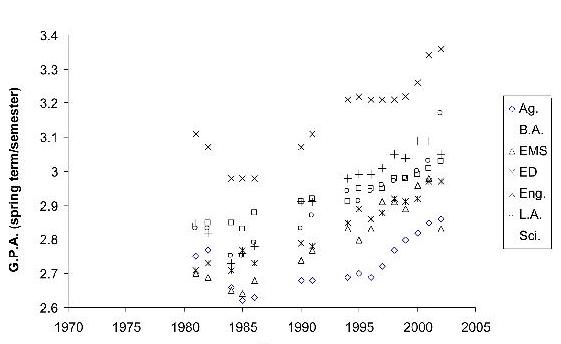
The following graphs are from the UFS report. The first graph is of average GPA versus time. It shows a steady increase in the average GPA at Penn State since the late 1980's. It went from around 2.80 to 3.05 on a four point scale in about fifteen years. The report also looks at average GPA across time for each of the colleges in the University. The second graph shows, that while the grading standards in each school differed, the overall trend is present in each.


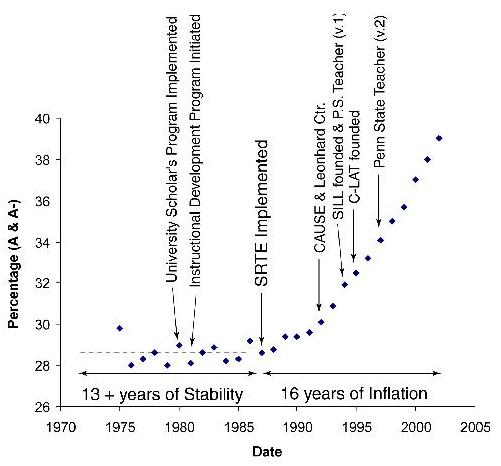
The third graph uses percentage of A's awarded as a measure of grade inflation. It too shows the same upward trend starting in the late 1980's that the average GPA graph does. In the last year shown proportion of A's awarded stood near 40%. At the beginning of the inflationary period this proportion was less than 30%.


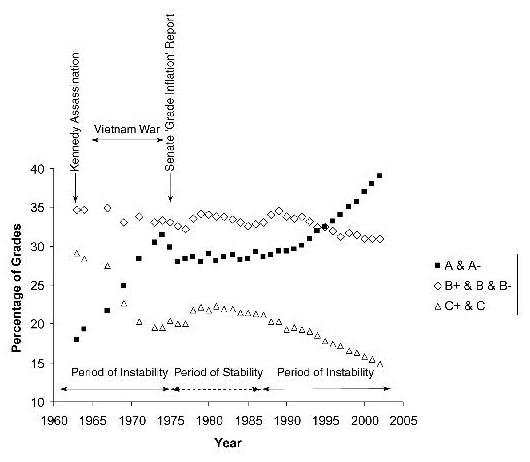
Everyone is aware that grade inflation was a problem during the Vietnam Era when faculties did not want to condemn students to Vietnam by flunking them out and and ending their student deferments. The next graph places the current period of inflation in the context of the Vietnam Era inflation. The current inflation in the number of A's awarded at Penn State far exceeds that of the Vietnam Era. The rate of inflation during the Vietnam Era appears to be greater than the current period, but constant. The current inflation rate appears to be increasing.


There is another distinction in these periods. The Vietnam Era inflations in grades were at the expense of C's given. The current inflation is at the expense of both B's and C's. In the mid 1990's the percentage A's awarded first surpasses the percentage of B's awarded. This makes A's by far the most often awarded grade at Penn State.

The Faculty Senate Committee sought an explanation for the current inflation. To this end, the following annotated graph was produced to place the inflation in the context of changes made within the University that might effect the grade distribution.


All of the changes noted, with the exception of the SRTE implimentation, are those which should have a positive effect on student learning. SRTE stands for Student Rating of Teaching Effectiveness. In 1987 these student feedback instruments were instituted. Grade inflation followed. All of the possilble other explanation for grade inflation don't stand up to scrutiny, including the idea quality of students admitted to Penn State has increased. The graph of average SAT scores of matriculating freshman versus time shows no systematic increase during the recent inflationary period.


The Faculty Senate danced around the obvious explanation of the cause.
It is very difficult to say exactly what is driving the present increase in GPA over time and why. Because the onset of the increasing GPA is closely tied to the implementation of the SRTE we could argue that the SRTE has had the effect of providing an incentive for the faculty to improve their teaching skills and that improvement is manifested by better grades. Another possibility is that the increase in GPA over time is a consequence of easier grading by faculty seeking higher SRTE scores. We could also argue that there was a delayed benefit from initiating such teaching and learning institutes as the University Scholars Program and the Instructional Development Program. The effect of these trends continued throughout the 1990s as other teaching and learning endeavors came on line as well. However, mean and median SAT scores of incoming students do not support the argument that GPA is increasing because the Penn State student is better prepared than ever before when entering the university.
Based on my observations of faculty grading habits, my money is on easier grading as a result of the SRTE. Along with dodging an explanation for the recent period of grade inflation, the committee settled on some very weak measures to deal with the problem.

1. Grades continue to be assigned solely on the basis of the instructor's judgment as to the student's scholastic attainment as long as the assignment is consistent with university, college, division, and department standards.

2. The President of the University in conjunction with the Deans and Department/Division Heads actively encourages faculty and undergraduate program heads as they work to define, implement, and maintain the standards they deem most appropriate for achieving a vision like one of those depicted in Figure 9.

3. Units actively monitor grade changes over time, take the action necessary to fully understand the reasons for changes, and remedy the situation when it becomes apparent that standards are being compromised and the vision for the institutional standards is not being achieved.


If Spanier is sufficiently serious about changing Penn State into a well respected institution and wants to rid the University of its party school image, it is time for him to grab the bull by the horns and take steps to raise academic standards for undergraduates. I'm not holding my breath. Spanier is all about image, but he won't tackle the tough problems at the core of the image problems. Further he himself is far too anti-intellectual to be an effective intellectual leader.