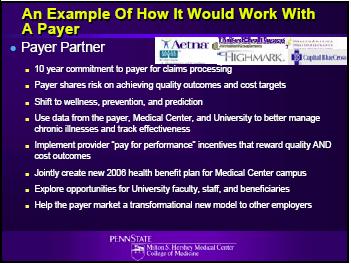
As you all know, Highmark Insurance company recently received a contract to administer Penn State's self-insured healthcare plan. The announcement of this contract was concurrent with an announcement that Highmark was "donating" $25 million to Penn State. Penn State has a long history of extracting such "donations"--some might say kickbacks--from coporations looking to do business with it.
The first such deal was back in 1992 with Pepsico. In return for a ten year contract, which has since been renewed, to run the University's vending machines Pepsico donated $14 million to the University. The bulk of that money went to the construction of the Bryce Jordon Center. Other deals have been struck since then.
In 1994, ATT was given exclusive rights for long distance service in exchange for a $10 million dollar "gift". In 1998, Penn State changed the student ID card it issued to a high tech card called ID+. Amongst it features, should a student elect to activate it, was the ability to use it as an ATT calling card. Technology, i.e. cellphones, has since made this feature obsolete.
But there were other features. Again should a student decide to activate the feature, the card could also be used as an ATM card. Initially, the card could be used at the ATMs of banks in the state owned by Keystone Financial Corp. In 1999, several banks, including PNC Bank, lost their campus ATMs because they chose not to participate in the ID+ system.
"The management here at PNC likes to partner with Penn State whenever they can," said Rob Rutz, vice president of public relations of PNC in Camp Hill. "The opportunity just didn't integrate well with the bank's business strategy."Then some odd developments occurred in 2002. In January, PNC Bank, which had not participated in the ID+ system, signed on to it. At the same time, Mellon/Citizens Bank, which had been part of the system, dropped out. Here is how the Collegian described the situation.
This past fall, PNC expressed interest in joining the program and signed a contract with Penn State and the ID+ program. Since Citizens Bank had never signed an actual contract with the program, the company was asked to remove its ATMs from campus so that PNC could move in.How much did PNC give PSU? The terms of the PNC contract, so far as I know, have never been revealed, but one might guess that a "gift" to the University was involved and that Mellon/Citizens Bank didn't want to sign a contract, that is pay-to-play. Several years earlier PNC Bank had donated $1 million to Penn State's new IST School, but, as the Pepsico and ATT deals reveal, that is unlikely to be enough of a sweetener to swing the deal.
Not surprisingly, as a result of the deal between Penn State and PNC Bank, all of the Mellon/Citizens Bank campus ATMs were switched to PNC Bank ATMs. And then in April of that year, after PNC had obtained a near monopoly on campus ATMs, Penn State discontinued the ATM feature on the ID+ card, which took away any incentive students may have had to use banks other than PNC Bank which participated in the ID+ system.
Giving Pepsico a monopoly on campus soft drinks isn't really that big of a problem in my view. Sure administrators may occasionally send out a draconian email in order to enforce the monopoly.
The e-mail message said that faculty members could no longer purchase products from Pepsi's competitors with university funds because of the university's exclusive contract with Pepsi.And then have to back track.
Coke-drinking faculty members can relax. Despite an e-mail message sent to some faculty members two weeks ago, university officials said faculty can still be reimbursed for nonbulk purchases of products from Pepsi's competitors.But in the end, this is about what sugar water one drinks and I can't get too worked up over it. However, a deal which subtly steers students toward a particular bank is morally questionable. It may even be illegal. There is a current scandal brewing over kickbacks to colleges and universities by student loan companies in return for steering loan business to them. The ATM deal looks to me to be a close cousin of the loan deals.
There are many other examples of Penn State extracting "donations" from companies that wished to do business with them. Students in Jane Juffer's English 240 class of Spring 2005 looked at many of these deals. You can see their findings here.
This brings me back to the Highmark deal. At this stage we don't know what the consequences of the deal will be and whether it will be executed on the up and up. However, today brings news of another donation which Highmark recently made (h/t Keystone Politics)
Highmark Inc. agreed to pay a fine of more than $54,000 for using corporate dollars on fundraising events connected to former Pennsylvania Sen. Rick Santorum.I would just like to point out that this voluntary admission was made by Highmark after it realized that its investment in Santorum wouldn't be paying any dividends.In announcing the penalty yesterday, the Federal Election Commission also said it assessed a $20,000 fine against a former Highmark vice president and a $7,500 fine against Mr. Santorum's political action committee, America's Foundation. The donations went toward three golf tournaments at the Country Club of Hershey and a private fundraiser, the FEC said.
The Pittsburgh-based health insurer voluntarily made the FEC aware of the apparent violations after an internal audit, the commission said. "We believe that Highmark's response to this matter demonstrates the value of its integrity program in facilitating the investigation, reporting to proper authorities and implementing remedial actions," said company spokesman John McDermott.
Mr. Santorum, a two-term Republican, lost his re-election bid in November to Democrat Bob Casey.
The sleazy behavior exemplified, on the part of Highmark, by the Santorum donation and, on the part of Penn State, by the PNC Bank deal should raise a red flag about the Penn State Highmark deal. Faculty may end up paying off the $25 million dollar "donation" through higher healthcare premiums and reduced coverage.
Technorati Tags: Penn State, Highmark, Pepsico, PNC Bank, AT&T, Santorum, corporate university
Powered by ScribeFire.